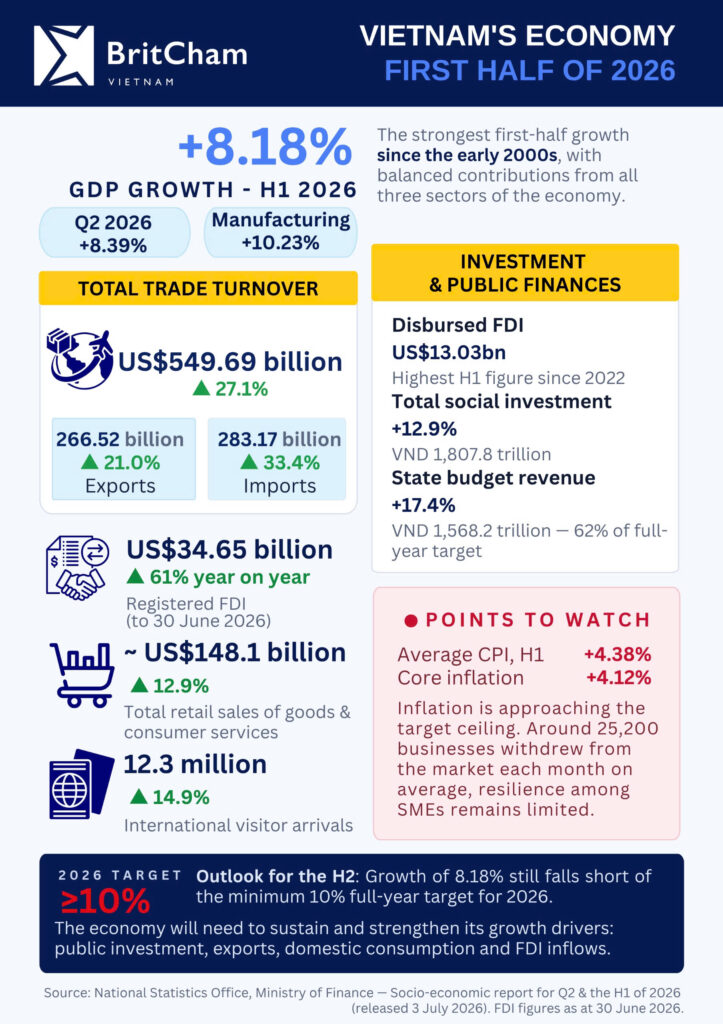
Vietnam’s macroeconomic trajectory concluded the first half of 2026 on an exceptionally strong footing, registering a stellar +8.18% GDP growth. This represents the country’s most robust first-half performance witnessed since the early 2000s, driven by an accelerating second quarter which recorded a growth rate of +8.39%.
According to official data from the National Statistics Office and the Ministry of Finance, the economic recovery exhibits balanced contributions across primary sectors. Industry and construction expanded by +9.81%, heavily propelled by the manufacturing sector (+10.23%), which continues to serve as the main engine of output growth.
International trade turnover scaled up to US$549.69 billion (up 27.1%), placing Vietnam on track to hit an unprecedented US$1,000 billion milestone by the end of 2026. While the trade balance shows a temporary import surplus of US$16.65 billion, 94.1% of these imports consist of production materials, indicating that businesses are aggressively accumulating inputs for the upcoming production cycle.
Foreign Direct Investment (FDI) remains the most prominent highlight. Registered capital achieved historic milestones at US$34.65 billion, an extraordinary 61% expansion year-on-year, while actual disbursement reached a multi-year high of US$13.03 billion.
Despite standard-setting headlines, structural vulnerabilities persist. Average CPI for the first half climbed to +4.38%, tightly approaching the government’s target ceiling. Furthermore, an average of 25,200 businesses withdrew from the market every month, signifying that localized fiscal pressures remain severe for small and medium-sized enterprises (SMEs). With the full-year target set at ≥10%, sustaining this momentum through public investment and FDI inflows will be critical for H2.